Puja, Poetry and Performance: Enduring Bhakti Traditions in the Indian Subcontinent
-
|
05 Aug
26 Aug
2026
|
Indian Aesthetics
|
|
Various Scholars
|
Image: Sanmukha_Tamilnadu -Madurai region_ Nayaka_ Late 17th century_ Ivory_ 8 x 5.5 cm
Puja, Poetry and Performance: Enduring Bhakti Traditions in the Indian Subcontinent is a four-lecture series focusing on various strands of the bhakti tradition in the region. Both texts and material evidence confirm the great diversity of religions and their affiliated cultures that have thrived here for more than two millennia. Apart from ‘mainstream’ religions, for instance, those known today as Buddhism, Jainism and Hinduism, many other religious streams which are designated as ‘popular’ also existed. These myriad religious views and practices in society were not isolated; coexistence meant that they often re-envisioned themselves as they cross fertilised. This series will delve into Shaiva Bhakti and the Tevaram; explore the veneration of Murugan, particularly popular in Southern India, from an early period; examine the dramatically performative Navratri festival as well as the poetry of the Vaishnava Alvars.
5th August 2026
The Tevaram hymns: Tamil Shaiva Bhakti in text and performance
- Dr. Indira Peterson
12th August 2026
Murugan: Deity of Early Tamilnadu
- Dr. Richard Davis
19th August 2026
The history, piety, and performance of the “kolu” navaratri rituals in south India
- Dr. Vasudha Narayanan
26th August 2026
Immersed in Visnu: An Introduction to the Aḻvars
- Dr. Archana Venkatesan
Online Public Seminar Series on ZOOM
Lectures in this series will be recorded and made available for 24 hours via a secure Zoom link on a scheduled date, subject to scholar consent due to the nature of ongoing research.
P.S: The Zoom link to join the lecture will be shared 24 hours prior to the talk.
Duration -
August 5, 12, 19, 26, 2026
Timing: Lecture: 6:30 - 8:30 pm IST
Fees
Rs. 4,000
Registrations Closed
Archana Venkatesan
Archana Venkatesan is Associate Professor of Comparative Literature and Religious Studies at the University of California, Davis. Her research interests are in the intersection of text, image and performance in South India. Her books include The Secret Garland: Āṇṭāḷ’s Tiruppāvai and Nācciyār Tirumoḻi (2010), A Hundred Measures of Time: Nammāḻvār’s Tiruviruttam (2014), Endless Song: Nammāḻvār’s Tiruvāymoḻi (2020), and with Crispin Branfoot, In Andal’s Garden: Art, Ornament and Devotion in Srivilliputtur (2015). She is currently working on a project on nine interconnected Viṣṇu temples in Tamil Nadu known as the Nava Tirupati.
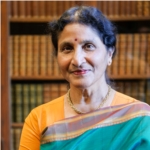
Indira Viswanathan Peterson
Indira Viswanathan Peterson is Professor of Asian Studies, Emerita, Mount Holyoke College, USA. She has a B.A. in English literature from Bombay University and an M.A and Ph.D. in Sanskrit and Indian Studies from Harvard University. She has also taught at Columbia University. Dr. Peterson specializes in Indian literature in Sanskrit and Tamil, Hinduism, and South Indian cultural history and performing arts, especially Karnatak music and early modern dance drama. Other interests include translation, culture contact, and comparative literature. She has published numerous articles and books on these subjects, supported by fellowships from the National Endowment from the Humanities, the Guggenheim Foundation, the American Institute of Indian Studies, the German government’s Alexander von Humboldt Foundation and other organizations.
Dr. Peterson’s major publications are the books “Poems to Śiva: The Hymns of the Tamil Saints” (1989), “Design and Rhetoric in a Sanskrit Court Epic: The Kirātārjunīya of Bhāravi” (2003), and “Arjuna and the Hunter” (2016) ,the first complete English translation of the Sanskrit Kāvya poem Kirātārjunīya. Other publications include: George Michell and Indira Peterson, “The Great Temple at Thanjavur: A Thousand Years. 1010 – 2010” (2010) and “Performing Pasts: Reinventing the Arts in modern South India”, co-edited with Davesh Soneji (2008). Indira Peterson is completing “Tanjore Renaissance: King Serfoji II and Indian Modernity,” a biography of the 19 th -century royal polymath Serfoji II of Tanjore. Also in progress is the monograph “Drama, the Court and the Public in Early Modern South India.”

Richard Davis
Richard H. Davis is Research Professor of Religion and Asian Studies Programs at Bard College, Annandale-on-Hudson, NY, where he taught from 1997 to 2022. Previously he taught as assistant and associate professor in the Religious Studies Department at Yale University, 1987-1997. During that time he was also involved in helping establish the Committee on South Asian Studies of the YCIAS. He received a BA from the University of Chicago, an MA from the University of Toronto, and his PhD in the Department of South Asian Languages and Civilizations at the University of Chicago in 1986.
His primary research interest is in the long-term history of Hindu religious traditions. His most recent publication is The Bhagavad Gita: A Biography (Princeton University Press, 2014), which traces this important Hindu text over two millennia of its reception history. He is author of four other books: Ritual in an Oscillating Universe: Worshiping Siva in Medieval India (Princeton, 1991), Lives of Indian Images (Princeton, 1997, winner of the 1999 A.K. Coomaraswamy Award), Global India, circa 100 CE: South Asia in Early World History (AAS, 2010), and A Priest's Guide for the Great Festival (Oxford, 2010). He has edited two volumes, and also wrote the text for a catalog of Indian religious prints, Gods in Print: Masterpieces of India’s Mythological Art (Mandala, 2012). He has received fellowships from the Guggenheim Foundation, the National Endowment for the Humanities, the American Institute of Indian Studies, and the Fulbright-Hayes Fellowship.
He is currently completing work on a book-length history of religions in early South Asia. This narrative history explores the origins and early development of the multiple religions that found their place in the Indian landscape in ancient and classical times: Hinduism, Buddhism, Jainism, and other less-known religions. The time range in this text runs from the earliest archeological evidence of religious practices in the subcontinent up to the period around 650 CE, a point of transition from “classical” or “late antiquity” to “early medieval” historical periods. His lectures at Jnanapravaha will be based on this current work-in-progress.
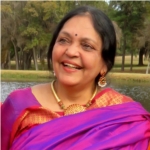
Vasudha Narayanan
Vasudha Narayanan is Distinguished Professor, Department of Religion, and Director, Center for the study of Hindu Traditions (CHiTra) at the University of Florida. She is a past President of the American Academy of Religion (2001-2002) and was elected to the American Academy of Arts and Sciences in 2023. Vasudha Narayanan was educated at the Universities of Madras and Bombay in India, and at Harvard University. She is currently working on Hindu temples and traditions in Cambodia. She is the author or editor of nine books and numerous articles, chapters in books, and encyclopedia entries. In addition, she is also the associate editor of the seven-volume Brill’s Encyclopedia of Hinduism. Her research has been supported by grants and fellowships from several organizations including the Centre for Khmer Studies, the American Council of Learned Societies, National Endowment for the Humanities, the John Simon Guggenheim Foundation, the American Institute of Indian Studies/ Smithsonian, and the Social Science Research Council.